
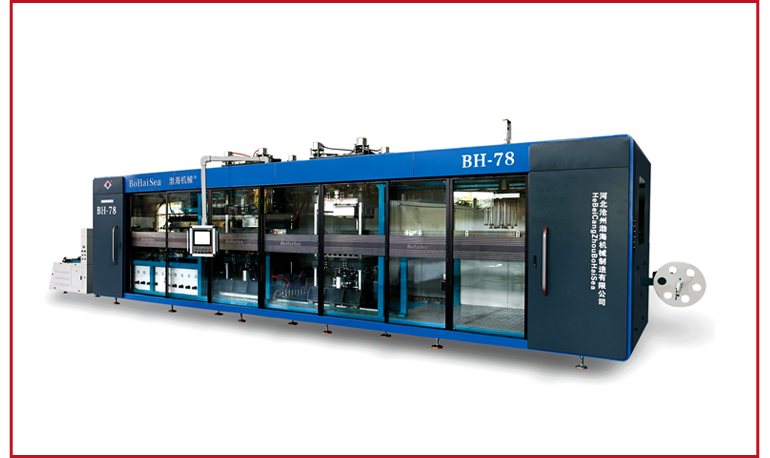
FEATURES
• Mechanical, pneumatic and electrical integration. Each action program is controlled by PLC. Touch screen operation is simple and convenient.
• Positive and negative pressure cooperate with each other to form.
• The upper and lower mold forming methods.
• Servo feeding, stepless length adjustment, high speed, accuracy and stability.
• Multi-stage heating of upper and lower electric heating furnace.
• The temperature control system of the electric heating furnace adopts full computer intelligent automatic compensation control. The division one control and the other adopts the human-machine interface digital input. It has high fine-tuning accuracy, uniform temperature and stability (not affected by external voltage, temperature fluctuations do not exceed 1 degree), Low energy consumption (about 15% energy saving), long service life of the furnace plate and other advantages.
• The forming and cutting unit is controlled by servo motors for mold opening and closing, and the products are automatically counted and output.
• The products are stacked in a variety of ways, because the products can be customized.
• With product data and parameter file memory function.
• The width of the film feeding chain rail can be adjusted automatically or separately.
• The electric furnace is automatically removed from the device.
• The mechanical feeding roll device reduces the labor intensity of workers.
PRODUCT PARAMETER
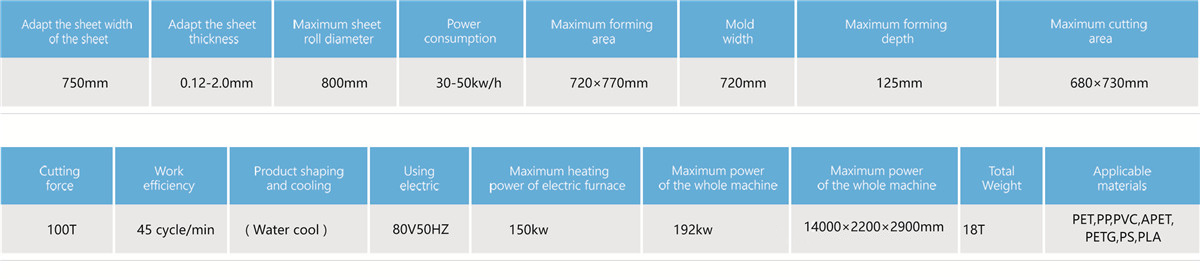
MAIN COMPONENTS
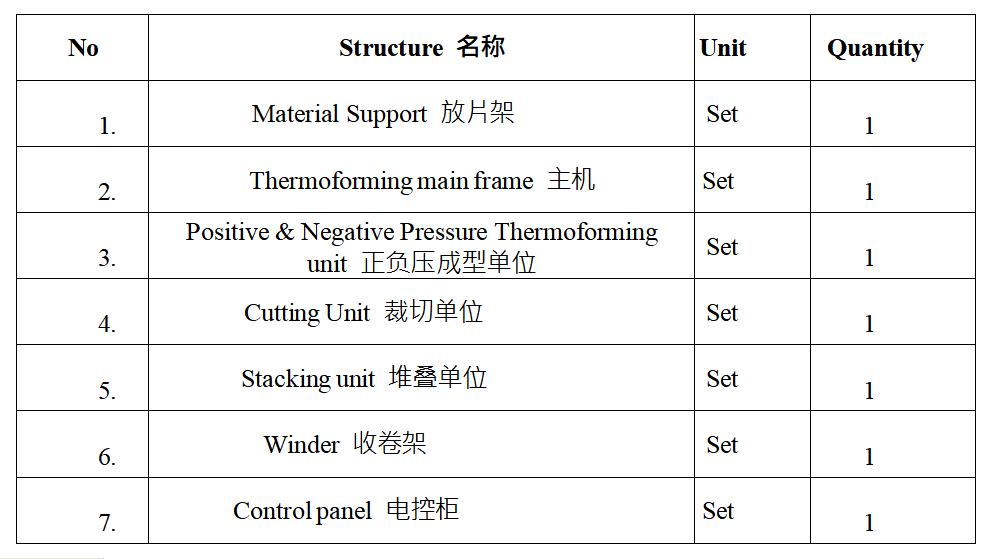
MAIN PARAMETERS
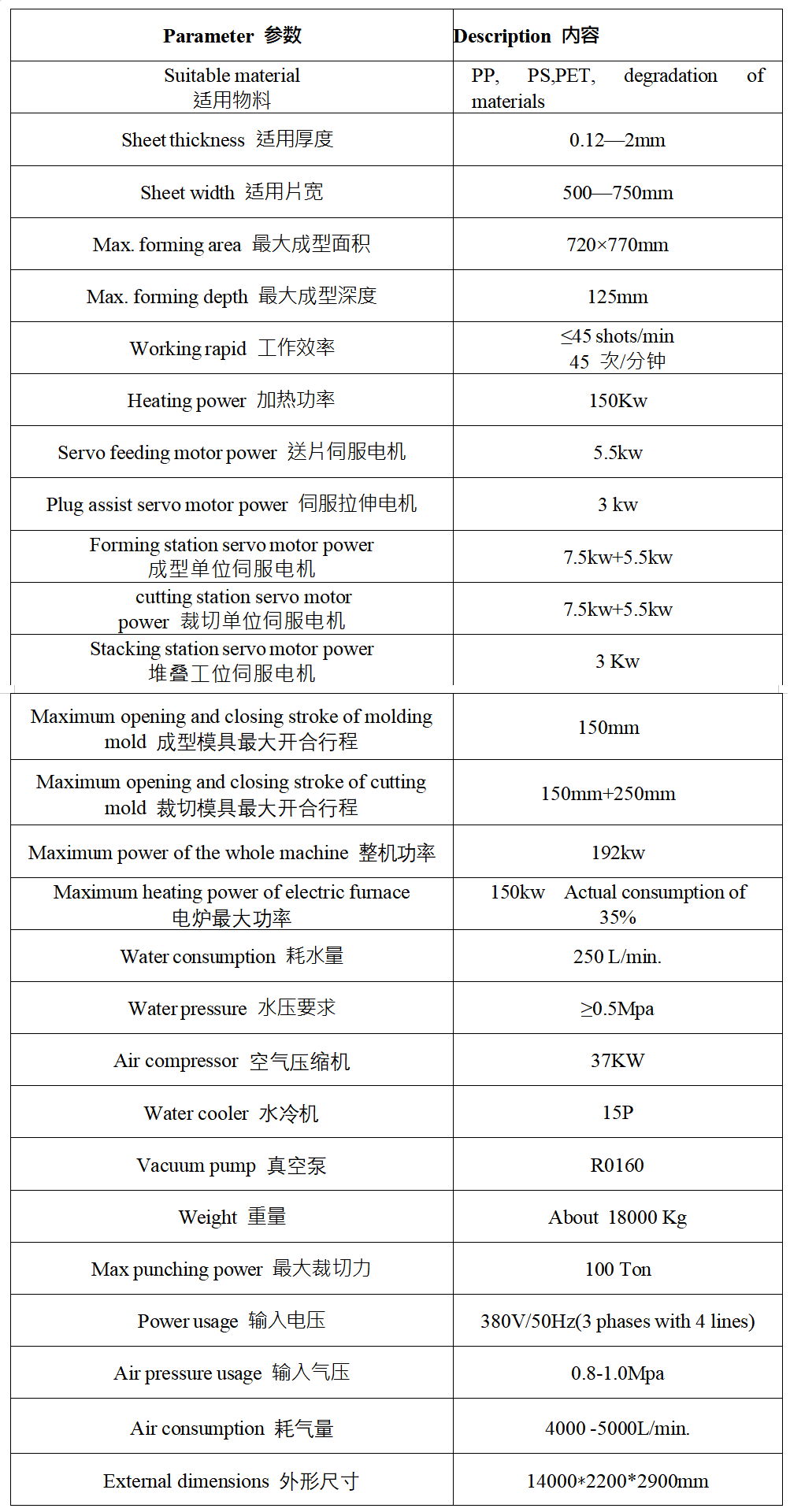
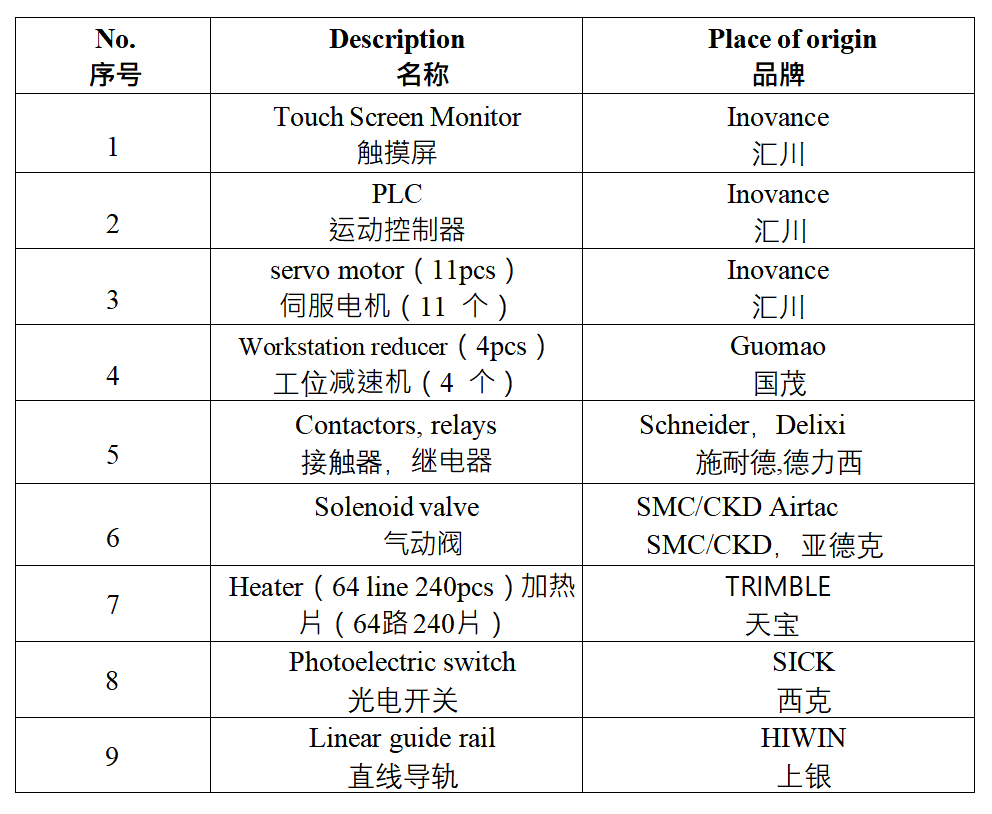
MAIN ELECTRICAL PARTS
MACHINE DETAIL
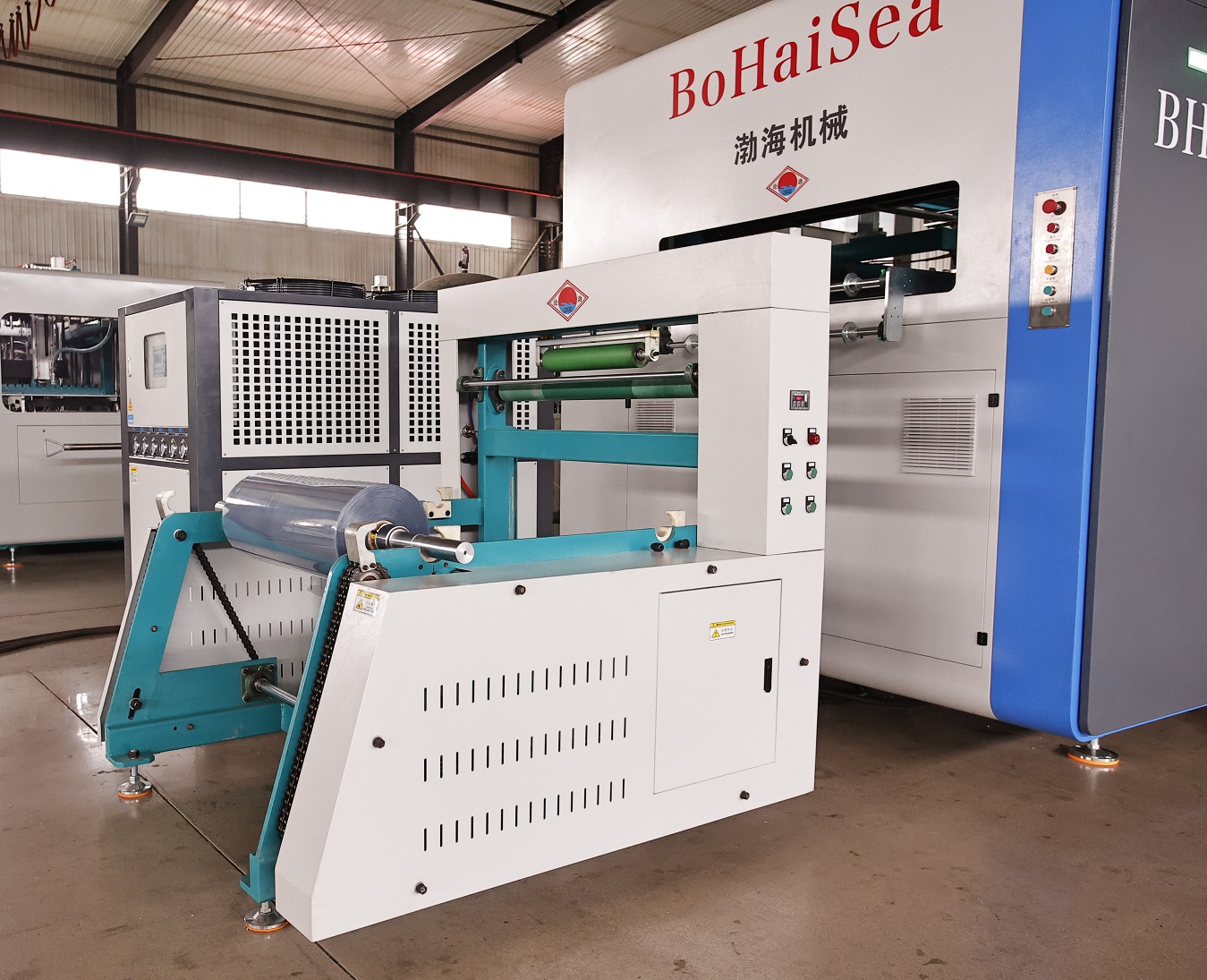
Some features of the material feeding support:
1. Coil loading and support
It adopts a heavy-duty steel structure frame and is equipped with an adjustable air shaft, which is suitable for plastic coils with different inner diameters (Φ50mm-Φ150mm) and outer diameters (≤Φ800mm).
The double-station design supports fast material change, reduces downtime, and improves production efficiency.
2. Intelligent feeding control
The servo motor drives the feeding roller, cooperates with the PLC program to achieve precise feeding speed matching, and runs synchronously with the thermoforming machine to avoid material accumulation or stretching fracture.
The pre-feeding function is optional to release the sheet tension in advance to ensure the flatness of the material during the forming stage.
3. High-precision tension adjustment system
Equipped with a pneumatic tension controller, real-time monitoring and automatic adjustment of sheet tension (usually in the range of 5-200N) to prevent material wrinkles, deformation or offset.
Supports manual/automatic mode switching to adapt to the tension requirements of different materials (such as PVC, PET, PS, PP).
4. Multifunctional compatible design
The width adjustment mechanism can adapt to sheet widths of 200-850mm and thicknesses of 0.1-2.0mm to meet diverse production needs.
The modular design supports rapid upgrades, such as adding an anti-static device or preheating module to improve material handling quality.
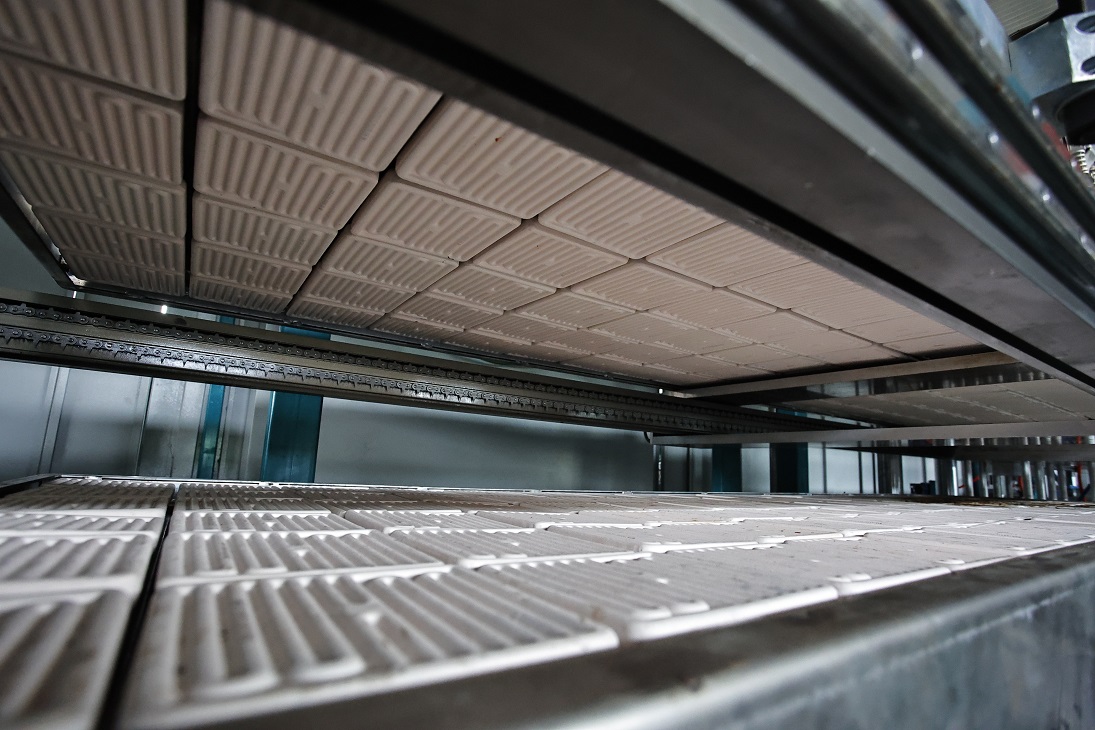
Introduction to the characteristics of the heating furnace
1. Radiant heating
Adopting high-efficiency infrared heating, covering the surface of the sheet, providing uniform radiant heat source, and quickly penetrating the surface of the material.
Multi-stage independent temperature control design can adjust the temperature gradient in the width direction of the sheet to meet the molding requirements of complex molds.
2. Suspension structure design
The upper furnace body is suspended by a hydraulic or pneumatic lifting mechanism, and the distance from the sheet (10-50mm) can be flexibly adjusted to match the heating depth requirements of materials of different thicknesses.
The opening and closing furnace door design facilitates mold replacement and daily maintenance.
3. Temperature closed-loop control
Integrated high-precision temperature control system, real-time monitoring of sheet surface temperature, feedback to the PLC system to automatically adjust the heating power, and the temperature control accuracy reaches ±0.5℃.
Supports preset multiple sets of temperature curves, adapted to different material characteristics such as PVC, PET, PP, etc.
4. Energy saving and safety protection
The furnace body is filled with high-temperature resistant insulation materials to reduce heat loss and reduce energy consumption by 15%-20%.
Equipped with over-temperature alarm, short-circuit protection and emergency shutdown functions, it meets the safety standards of industrial equipment.
5. The synergistic advantages of the upper and lower furnaces
Efficient and uniform heating: double-sided synchronous temperature control, the softening speed of the sheet is increased by 30%, and the thickness consistency of the finished product is more than 99%.
Flexible adaptability: compatible with sheet thickness 0.1-2.0mm, width 200-850mm, to meet diversified production needs.
Intelligent integration: linkage control with the molding machine and feeding rack to achieve a fully automated production process.
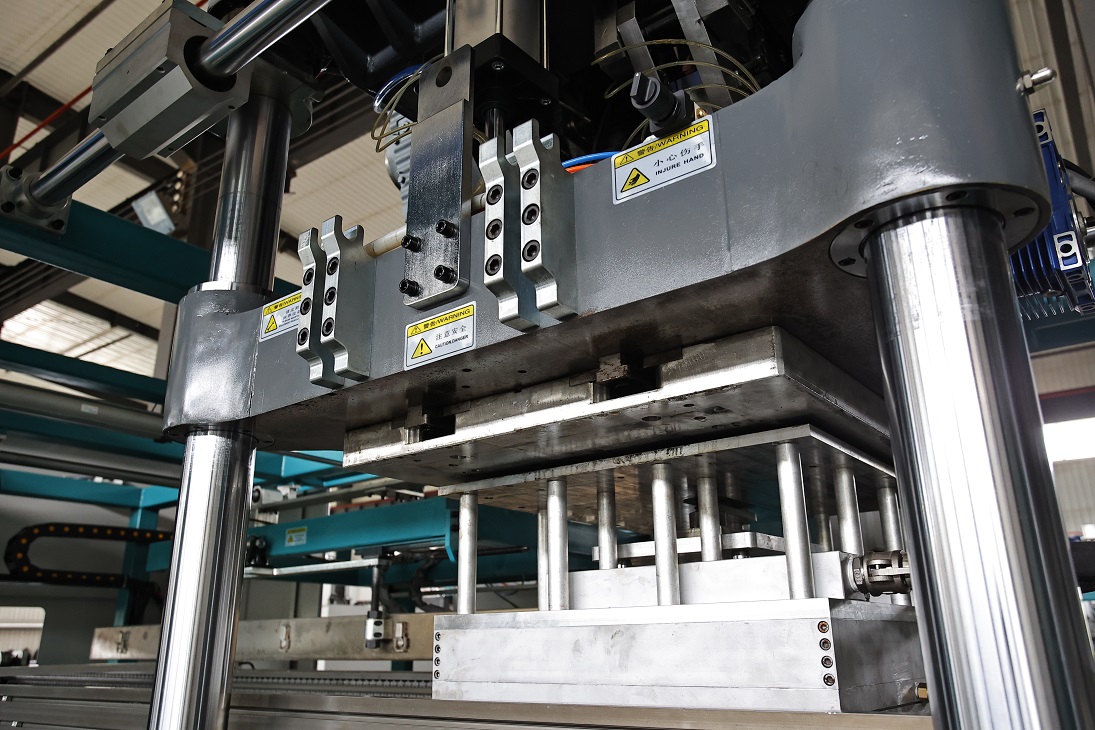
Introduction to Forming station:
Molding function: Through vacuum blistering and air pressure molding, the softened sheet is fitted into the mold for molding.
Structure:
Vacuum system: Equipped with a high-power vacuum pump (≥5.5kW), the vacuum degree reaches -0.08~-0.1MPa, and the sheet is quickly adsorbed.
Air pressure system: High-pressure air station (0.5-0.8MPa) assists blow molding to enhance the molding accuracy of complex structures.
Mold platform: Servo-driven mold lifting, stroke accuracy ±0.1mm; quick-change clamping mechanism supports mold change within 20 minutes.
Technical features:
Molding pressure, time, and vacuum degree parameters are independently adjustable.
Multi-cavity synchronous molding (such as 1 out of 4, 1 out of 6) is optional to improve single-time output.
Cooling function:
Function: Rapidly shape the molded product to prevent deformation or shrinkage.
Structure:
Air cooling system: High-pressure fan with annular air knife to evenly cool the sheet surface.
Water cooling system: The mold has built-in cooling water channels, which accelerate cooling through circulating water (10-25℃).
Technical features:
Adjustable cooling time (3-15 seconds) to adapt to the cooling rate of different materials.
Intelligent temperature control to avoid stress cracking caused by excessive cooling.
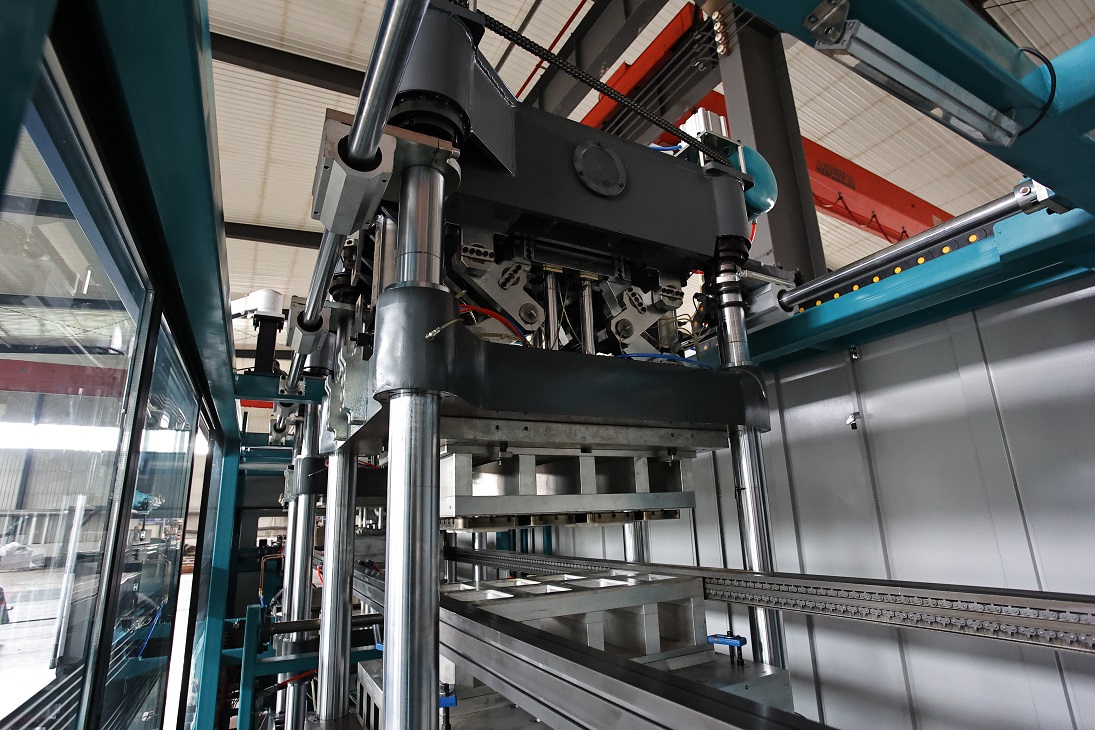
1. High-precision cutting system Function:
Through the cooperation of mold and punching force, the formed sheet is cut and separated according to the preset shape to ensure that the product edge is free of burrs and deformation.
Structural composition:
Punch mechanism: servo motor drive, providing stable cutting force (adjustable from 10 to 100 tons), adapting to different materials (PVC, PET, PP, etc.) and thickness (0.1-2.0mm).
Cutter system:
Upper die: carbide steel, titanium-plated surface, wear-resistant life ≥ 500,000 times.
Lower die seat: precision-machined aluminum plate or steel plate, equipped with cushioning rubber pads to protect the knife edge and reduce noise.
Guide mechanism: high-precision hard guide column to ensure that the upper and lower mold alignment accuracy is ≤ ± 0.1mm.
3. Dynamic positioning and synchronous control
Function:
Ensure that the cutting position is completely aligned with the formed product to avoid dimensional deviation caused by offset.
Key technologies:
Linked with the molding station: PLC controls the cutting rhythm and the molding cycle to match the production line rhythm (6-45 seconds/mold).
Technical advantages and innovative design
1. Ultra-high cutting accuracy
Adopting servo closed-loop control, the cutting repetition accuracy reaches ±0.1mm, meeting the ±0.2mm tolerance requirements of electronic component trays, optical lens packaging, etc.
Profile processing capability: supports cutting of complex shapes such as rounded corners, sawtooth, and hollowing, with smooth cuts and no burrs.
2. High-efficiency and energy-saving design
The servo drive system saves 30%-40% energy compared to traditional hydraulics, and the noise is ≤75dB.
Automatic waste recovery rate ≥95%, reducing the waste of raw materials.
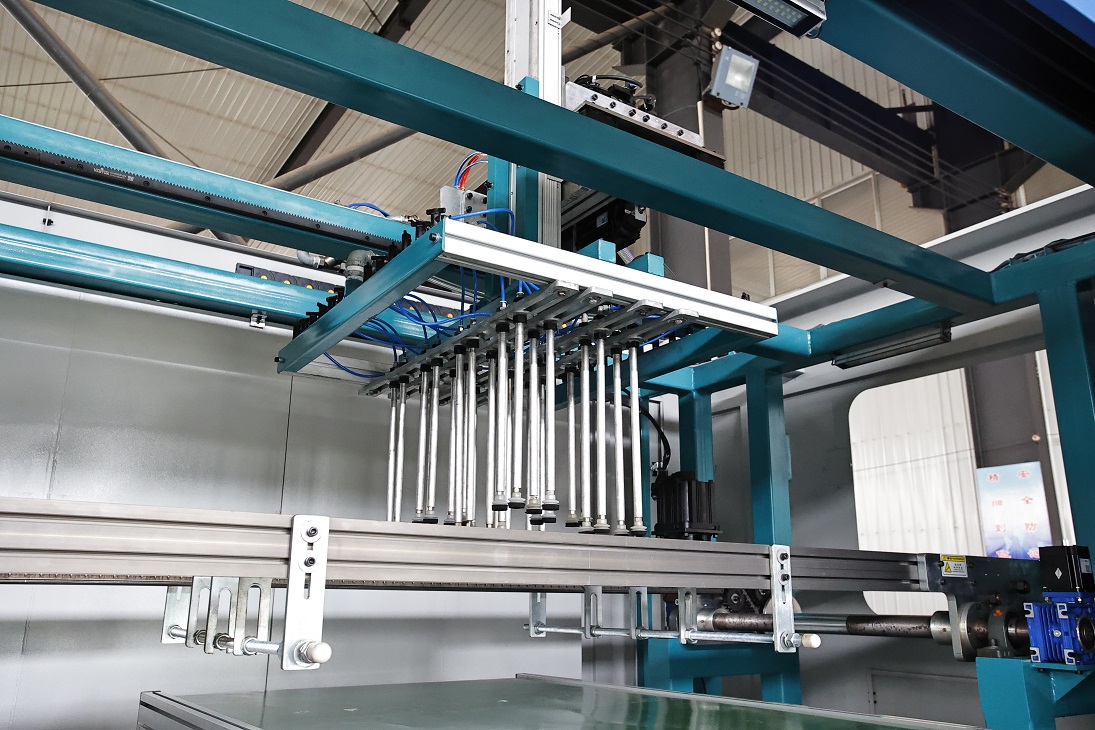
Stacking station introduction
Automatically stack finished products according to the preset number of layers and arrangement methods (such as horizontal stacking, staggered stacking).
Equipped with adaptive suction cup clamps.
The servo motor drives the lifting platform, which automatically descends to a fixed height after each layer of stacking is completed.
The lever mechanism arranges the products horizontally to ensure the alignment accuracy within the layer of ±1mm.
Finished product output and cache
Function:
The finished product group that has completed the stacking is automatically output and temporarily stored, and the packaging process is connected.
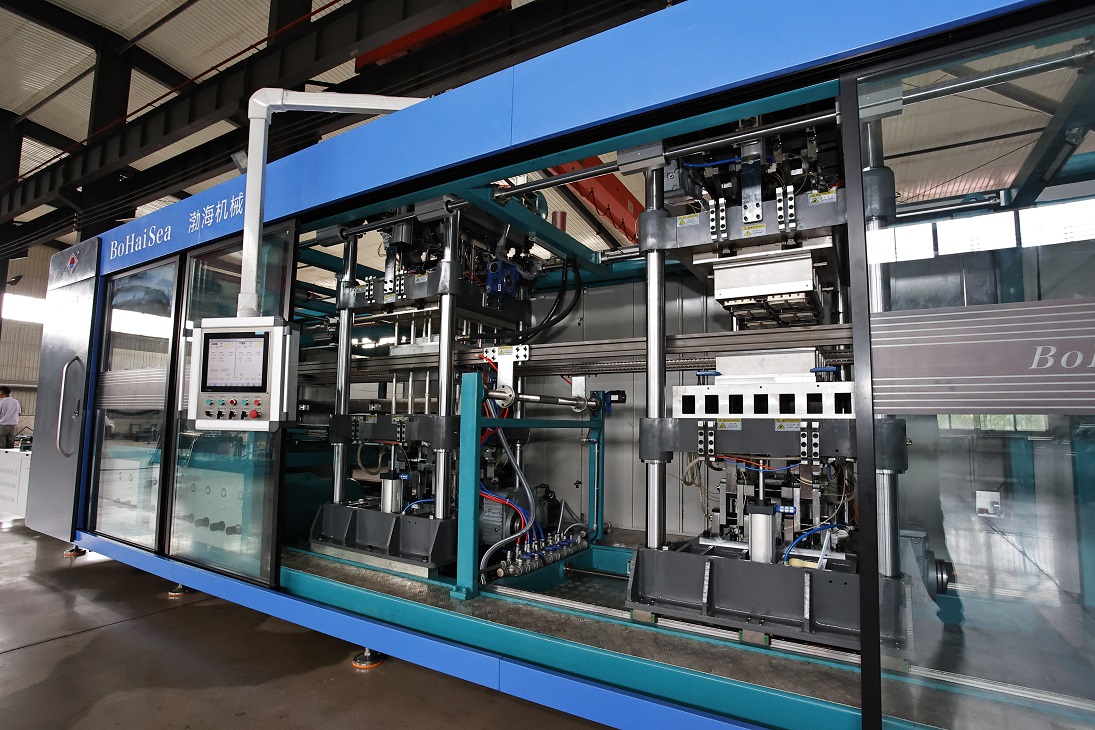
Visual interface design:
Adopt 15-inch high-definition touch screen to dynamically display the operating status of the equipment (such as heating temperature, molding pressure, feeding speed, etc.).
Real-time display of collaborative operations of each station (such as loading → heating → molding → cutting → stacking), with clear operation logic.
Automatically count key indicators such as output, yield, energy consumption (kW·h/thousand pieces), equipment utilization (OEE), etc.
Generate daily/weekly/monthly reports, and support Excel/PDF format export.
Industrial Internet of Things (IIoT) integration:
Support Modbus TCP/IP, Profinet, Ethernet/IP protocols, and seamlessly connect with MES/ERP systems.
Remote monitoring function: View the device status in real time through PC or mobile APP and receive alarm push.

leave a comment